Being built. The core and the studio work; the architecture playground is nearly complete; the oversight, intervention, reinforcement-learning, agent and acceptance stages are specified, not built. No research claim is made until the studio passes its own acceptance suite.
What MindMint is
A neural-network architecture sandbox with oversight built in. Every experiment is a file: the network as a graph of blocks, the data, the training phases, the windows to read and the decisions they may inform. The same file runs on a laptop CPU or on several GPUs, because the science and the hardware are described separately. Every run writes a manifest from which it can be reproduced, and every decision that touches a window will be recorded in a ledger.
It is meant to be fun to tinker with at small scale and serious enough to scale up: a dark-mode studio with live strip charts, a canvas for editing the network, and a command line that a language model can drive.
Why build it
The hypothesis is about training: with enough windows into a model, honesty may become cheaper for training to find than evading every window at once. Testing that needs models trained from scratch with windows read at every step, decisions kept rare and coarse, sealed checks that training never touches, and an exact record of every way observation was allowed to influence learning. Existing training frameworks are built to make models better, not to keep observation separate from influence. MindMint is built around that separation.
It is also built for a second reason: many of the program's ideas are architectural. Settling networks, plastic weights and societies of small models may make some internal states easier or harder to hide. Those are questions only matched experiments can answer.
What it does
What the studio is built to do. Some of it works today and some is specified; where it stands says which.
Blocks that settle toward equilibrium, attention with fast-changing weights, cellular-automaton mixers, liquid time-constant cells, societies of small expert networks and learned byte patching sit beside the standard transformer, along with learning rules other than backprop. Blocks, learners, tokenizers, datasets and instruments are all plugins, each with contract tests it must pass before use.
Every new architecture is compared against a baseline at matched measured compute, with the same tokenizer and data. Every run is reproducible from its manifest, and blocks that think for longer are charged for it.
Windows read a model without changing it. Some are allowed to inform training decisions; others stay sealed, committed before training and never allowed to influence it. Every decision that uses a window is recorded in an append-only ledger, with an estimate of how much information it passed back into training.
Fine-tuning, distillation, removal of unwanted training, model surgery and comparison of internal geometry between models, with a record of where every model came from and what was done to it.
The same experiment runs on a laptop CPU or on rented GPUs; the science and the hardware are described separately. Open corpora such as TinyStories, and open models imported from Hugging Face.
A command-line interface with machine-readable output, and a console in the studio where a language-model agent designs and runs experiments within a budget. Every agent action is recorded, runs of record need a person's approval, and the agent never sees sealed results.
Where it stands
The studio is built in stages, each with gates it must pass before the next begins. The last stage is an acceptance suite: known-answer experiments that the instruments must get right, and leak attacks that try to move sealed information into training or decisions. The research program starts only when it passes.
First results
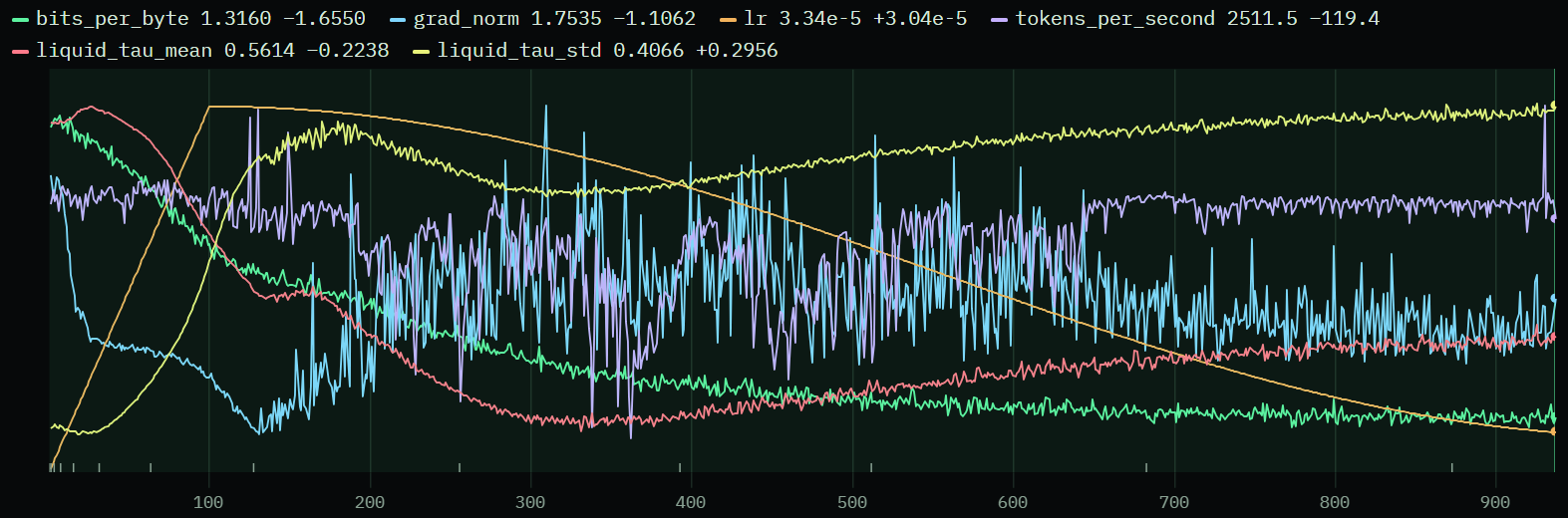
The playground's first runs are exploratory: small models on a laptop CPU, one seed, no criterion fixed in advance. They test the instrument as much as the ideas, and they are reported as they came out.
A small language model had its last feed-forward layer replaced by four expert networks that exchange messages over up to four rounds. Messaging made no difference: validation bits per byte was 1.1985 with one round (no messages), 1.1983 with two and 1.1983 with four. The shared state settled within about two rounds while the experts still disagreed, and the weights each expert gave the others' messages never moved from their starting values. The block behaved as four experts combined by learned weights. Every expert saw the same input, which may have left the messages nothing to carry; the next design gives experts different information. A null result for this design, not for the idea.
The full entry, with caveats, is on the results page. The MindMint repository is private for now, so entries do not link to code yet.
The goal: honest models
A reproducible, independently validated step toward models that represent the evidence they have faithfully, revise when they should, and resist incentives to misreport.
The first goal is a direct test of the hypothesis: models trained under many windows from the first step, with sealed checks training never sees, compared against models trained without them. Beyond that, the aim is to find architectural principles worth scaling with serious compute. Nobody here claims to have solved alignment, and even robust honesty is not the whole of it.
"Honest" is several properties, and each is tested separately, because a truthful sentence can be a guess, a coherent answer can be false, and an accurate internal representation can sit behind a deliberately inaccurate report.
Does the answer match independently established ground truth?
Does stated confidence track the actual error rate, including under shift?
Does real new evidence change the answer, and irrelevant input leave it alone?
Are the internal representations causally tied to the evidence, not just decodable by a probe?
Does the model report its best available evidence when the incentives push the other way?
Do stated plans and later actions agree?
Are goals, permissions and effects acceptable? Honesty alone does not settle this.
Many coordinated protocols
Instead of looking for one decisive intervention, the program's wider framing, Many Coordinated Alignment Protocols, looks for many partly independent mechanisms that complement one another, and measures how they combine. A protocol can act at different times and places: on the data, the architecture, pretraining, the evidence a model sees at run time, fine-tuning, reinforcement learning, oversight, transfer to a new model, or deployment monitoring. Some train, some constrain, some observe, some audit.
The distinctive unit of evidence is the interaction. Two sound methods can be redundant, interfere with each other or reinforce each other, depending on where and when they act. Interactions are measured with small factorial experiments (each method alone, both together, neither) at matched compute, replicated, and recorded with the conditions under which they held. The target is a frontier across accuracy, calibration, faithful reporting, robustness, capability and cost, never a single opaque "alignment score". The Extreme Oversight Hypothesis is one foundational component; the XonTools instruments are others.
Research on the research
The model under training is one subject of study; the process used to discover what aligns it is another. Because MindMint records every specification, budget, lineage and decision, it can compare research strategies themselves: a person directing the search, one language model proposing and interpreting tests, or several models in distinct roles (proposer, designer, critic, replicator) under equal budgets, judged on new problems none of them saw.
The measure is not the number of discoveries but how many survive independent replication per unit of cost, and how quickly false leads are killed. The strategy that rejects expensive dead ends fastest, while still noticing surprises, may be the best one. One rule holds throughout: no research strategy, human or automated, may optimize against its own final independent evaluation.
Research directions
Questions the studio is being built to ask. Each comes with the result that would count against it, and none is a claim of a result.
Do evidence-compatible representations occupy stable regions of a model's state space? The target is not stability for its own sake, since a stable false belief is not honest, but resistance to irrelevant perturbation combined with revision when real evidence arrives.
Does competent misreporting force some architectures to keep two representations, or spend more memory or computation? Compared against equally hard tasks that need two states without deception, the answer could favor honesty, favor deception, or show no difference.
Can a model repair a corrupted internal estimate from evidence it retains, without forcing agreement and without rejecting legitimate surprises?
Do societies of small models get more accurate by exchanging attributable evidence than by voting or free messaging, and can they tell five claims from one source from five independent observations?
Can a shared internal state couple evidence, reports, plans and actions so that one cannot drift from the others, and where are the bypasses?
Do local, equilibrium or fast-and-slow learning rules preserve accurate representations under pressure to misreport better than backprop does, or do they make a deceptive pathway more capable?
Can a freshly initialized student, trained on a teacher whose unwanted behavior has been suppressed, end up without that behavior in a recoverable form? One candidate among many, with a known risk: it could entrench problems nobody detected.
The first bridge between them is a synthetic world with hidden facts known to the experimenter: the model needs the facts to do one task but is sometimes rewarded for misreporting them. A small factorial on oversight and architecture, with fresh seeds and an independent sealed test, asks whether the two together do something neither does alone. A strong negative result is possible and useful: oversight metrics rise while sealed measures do not, or an apparent gain comes entirely from extra compute or from the model abstaining.
Toward larger models
The long-run aim is to compose the mechanisms that survive joint testing and train more capable models with them. Scale does not create honesty: more capacity can improve a model's picture of the world and also its ability to deceive. So a mechanism is promoted in steps: an effect in controlled models with known ground truth; reproduction on fresh seeds, new task families and independent measures; causal evidence for the proposed mechanism; and a registered prediction for the next scale, with a stop rule if it fails. The result might be an architecture with settling dynamics, shared internal state and diverse oversight, or a mostly conventional transformer with better training. The experiments choose, not the appeal of novelty.
A research federation
LONGER TERMEnvisioned, not built. One researcher with MindMint can explore unusual architectures with consistent contracts and fair comparisons. A federation of independent MindMint installations could make those explorations cumulative: an invitation-only network sharing hypotheses, experiments, results and reviewed components, without turning independent labs into centrally directed workers.
Experiments always run on the participant's own machine. The federation coordinates knowledge and opportunity; it never executes anything remotely, and nothing runs without local approval.
Experiments are typed, versioned specifications that anyone in the network can search, reproduce, fork and challenge. A fork, whether edited by hand or proposed by a language model in plain words, becomes a new, traceable experiment with its own status.
Each contribution is a signed claim about a specific run, linked to others as supporting, contradicting, qualifying or failing to replicate. Method quality and independence are recorded separately from the direction of a result, and no lab's reputation outweighs independent contrary evidence.
Shared queues avoid accidental duplication while deliberately encouraging independent replication, useful negative results and decisive falsifications.
New blocks, learners, instruments and datasets shared as reviewed, signed, versioned packages, installed only with separate consent, never automatically when someone pulls an experiment.
Results carry visibility classes, from open to sealed, so that a sealed test revealed in one lab cannot quietly steer another lab's choices.
The federation would also study itself. Its first experiment would give groups of researchers the same question and the same budget: one working independently, one with a shared registry, one with coordinated suggestions for controls and replications. The outcome measure is validated information gained per unit of resource. Success is not many reports but one result that another researcher can reconstruct from its signed record, fork meaningfully, replicate independently and trace through the work it influenced. If coordination costs and shared biases outweigh the benefits, the federation idea fails, and that would be worth knowing.
A network does not make a reported result trustworthy, and it does not solve alignment. Its promise is narrower: to raise the rate at which discriminating questions are asked, mistakes are caught, surviving effects are replicated, and better designs are built from what remains.
How this could fail
Strategic deception may not appear at the scale of these experiments, and larger models may find workarounds that small ones never needed.
Several methods are not automatically diverse. Instruments can rely on the same labels, coherence measures can reward cosmetic consistency, and a shared internal state can let one corrupted estimate poison everything downstream.
A probe that can read something from a model's activations has not shown that the model uses it. Claims about internal states need causal tests.
Hard evidence anchoring can freeze a wrong premise, consensus can silence a correct minority, and compressed state could make deception easier rather than harder.
Repeated searches can learn the boundary of a supposedly held-out test. The ledger and the sealed partition exist for this, and they constrain the researcher as much as the model.
A model can represent the world accurately and pursue unacceptable goals. Honesty makes values visible and correctable; it does not make them right.
A decisive defeat of one idea is not a defeat of the method. But if combinations of protocols keep failing on fresh independent tests, if interaction gains vanish once compute is matched, or if language-model research produces fewer replicable findings than simpler human-directed science, the program's design changes.
Who builds it
MindMint, the Extreme Oversight Hypothesis, the coordinated-protocols framing and the federation proposal are Ian MacKenna's. Claude (Anthropic) co-designed MindMint's specifications with him and Cursor implements them; ChatGPT helped refine the coordinated-protocols and federation proposals. Collaborators working on oversight, interpretability or unusual architectures are welcome: get in touch.